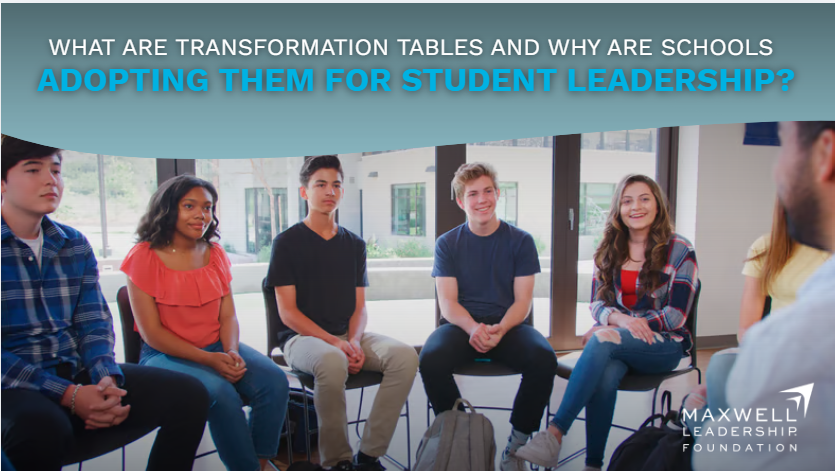

Imagine a group of 6 students in a circle, chatting while nobody is watching. One of the students, with a notebook in hand, speaks up asking a personal question about integrity from her own experience and not a textbook. Kids are listened to, challenged, and led in this space; their comprehension of what it means to be a leader they want to become is enhanced. That is exactly what a Transformation Table is and how it has influenced leadership development in schools.
The Purpose of Transformation Tables
Transformation Tables are a part of the Maxwell Leadership Foundation values-based leadership program and allow students to engage in important character topics through peer-led discussions. Leadership is influence, not position, and nowhere is that more visible than at a Transformation Table.
They are student-only to empower them to share and learn from each other.
Anatomy of a Table
A Transformation Table consists of groups of 6-8 students, who rotate to lead the conversation. That means they can see leadership in place rather than just talking about it. The rotating leader can then ask a thought-provoking question or give a great example of integrity or self-discipline. From this, the conversation is rich; students bounce ideas back and forth and hold one another accountable for their similar beliefs. It’s a dynamic and not scripted conversation, and the Maxwell Leadership Foundation believes that more nuanced discussions are better held in small and frequent sessions rather than in large conversations.
Why This Format Works
If traditional classrooms put an adult and children in front of each other, Transformation Tables change that so students can learn from each other. It gives students a sense of ownership and responsibility from the students’ point of view, so leadership is something they practice rather than something to be monitored. These conversations are ongoing and become a way of life, allowing them to share their values outside of assemblies.
This is done on a national scale; a Rwanda-based principal introduced the iLead curriculum (which is the base for Transformation Tables). Now, five years later, there are more than 3,000 students that have benefited from student-led discussions, as a generation of young people are now influencing each other through the curriculum.
What Students Experience
Walk into a room where students are having a Transformation Table and you’ll see positivity in the room. They chat with each other. They don’t look up to a teacher at the front of the room. The rotating leader struggles with their opening question, but the rest of the group is patient as they’ve experienced the same nerves before. A student who has been shy to speak up feels comfortable speaking up, and someone who is a dominant speaker learns that listening and giving others the space to share is important.
In this process, character is developed and practiced, and students grow consistently throughout the year. Students who started the year afraid of asking questions were able to rise up and lead by the next spring, a lot more confident than where they started. This “multiplication mindset” is not about creating one leader, but about giving students the opportunity to lead at every table, allowing influence to spread.
Why Schools Are Taking Notice
Educators and administrators are starting to fall in love with Transformation Tables because they solve the problem of retaining character education in schools. One assembly on integrity is unlikely to stick around long term, but a weekly conversation between peers will become second nature before you know it. And this model is scalable. There is no need for external speakers, but instead a culture of positive peer influence, guided by a simple curriculum.
The Maxwell Leadership Foundation has developed the iLead Student Leadership Curriculum for K-12 schools and provides schools with a full year of peer-facilitated leadership development. Every successful ripple, whether it starts in a small classroom in Kigali or expands to a multi-year program that has trained more than 200,000 leaders across Argentina, starts with a passionate person and a simple structure that allows it to grow.
Starting the Ripple in Your School
You can tell your students what it means to lead, but it is a whole different ballgame to learn how to become a leader. Transformation Tables like those from the Maxwell Leadership Foundation can help fill that void, turning leadership into a practiced skill rather than a talked-about idea. You will need to go ahead and introduce Transformation Tables and the iLead curriculum to your school or district at maxwellleadership.org to begin spreading your positive influence among your students.
“The most powerful ripple in any room belongs to the person who chooses to serve, not the person who is seen.”
What We Learned in Paraguay

The Stage Is a Microphone, Not a Generator
This is the core misunderstanding of how influence works. Most of us believe leadership influence flows like a broadcast signal: the more prominent the speaker, the more powerful the signal.
But influence doesn’t work like a broadcast. It works like a ripple. Ripples are generated by contact — by the specific, personal, relational moment in which one person’s character touches another’s.
🔗 Copy Link