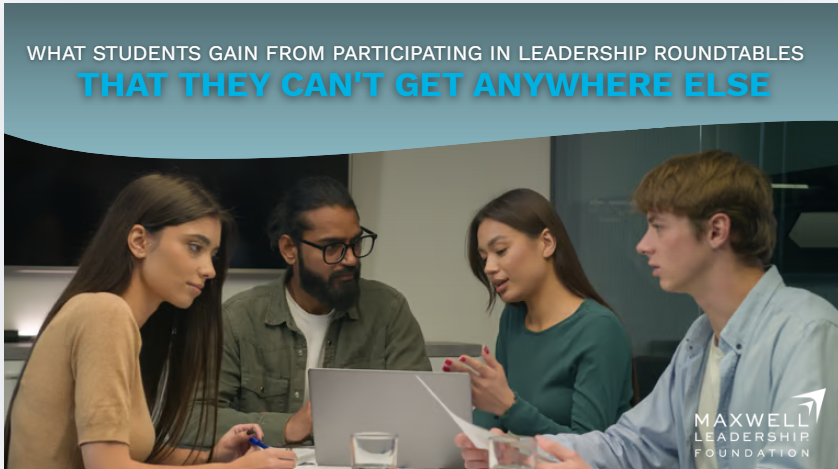

You have gathered the students in the classroom, rearranged the furniture and printed off a discussion guide for the roundtable discussion. After forty minutes you have three engaged students, one leader and a bunch of judging eyes focused on the clock. We’ve all been there. A roundtable discussion about leadership is not valuable to students, unless we make it so. Here’s how to do that, with strategies that are useful for leadership educators.
Start With the Room, Not the Rules
Arrangements of furniture send nonverbal communication to students about power in the room. A circle is meant to signify equality, while rows ask for a power dynamic, with the teacher at the front. Students need to be in a circle or around a table instead of on a podium at the front of the room. In addition, we need to remove visual barriers to discussion by getting rid of desks that separate students from the teacher’s desk at the front of the whole class.
We also need to keep the group small enough for everyone to feel like they are part of a group. 8-12 is a good number, while larger groups can be split up (with student facilitators for each sub group) or a student moderator who can call on people and prevent domination of the conversation by one or two students.
Design Prompts that Open Doors, Not Close Them
A fatal mistake made by facilitators is asking students a question with an answer that can be answered by stating a fact. Instead, we need to design questions that ask a group to tell a story. Effective questions have three characteristics:
They are personal rather than conceptual. Instead of telling students what to think about, ask for their opinion or perspective. For instance, “Tell us about a time when you had to choose between what was easy and what was right” rather than stating a definition of integrity.
They are specific enough to be answerable and vague enough to disagree about. Avoid yes and no or true false questions.
They are sequential. Start with lower risk questions and move to higher risk questions. Start with discussion starters and then move to higher risk questions that ask students to share opinions or experiences.
Themes that explore values based leadership like character, courage, humility or service should be framed as scenarios and then ask students to share an experience or opinion, which will lead to more meaningful dialogue than telling the students a story.
Use Silence as a Discussion Tool
When a cold, empty silence falls over the room after asking a challenging question, beginning facilitators get anxious and feel the need to do something. Instead, do nothing. Count to 10 in your head and then rephrase the question or turn to a specific student with an invitation. “What’s your instinct on this one?” And don’t fall into that scary tactic of repeating the question loudly as if the students need more clarification.
Count to 10 even if the whole group is staring blankly at you. And if they still are, don’t repeat the question at an even higher decibel the second time, rephrase it or turn to a specific student with an invitation instead.
Develop Student Facilitators, Not Just Participants
A good round table discussion builds a multiplication mindset and leaders who train leaders, while improving the skills of participants along the way. The ultimate goal of a student run round table discussion is not about you, but about your students.
Start with small leadership opportunities for students within the discussion, asking one student to read one of the discussion starters or calling on the next person to speak. After a few weeks, have a student lead the whole discussion with the same opening directions. Move toward more student facilitated discussion and by your second semester you can have a student run circle with you as an observer. This is the model of iLead Student Leadership Curriculum, which is entirely peer facilitated with round tables throughout the year.
What a Great Session Looks and Feels Like
You’ll know the session went well because the students felt in control. Good round table discussions will feel like everyone in the room has the assurance that they can speak vulnerably and move on without the teacher. Students may even surprise you and go deeper or longer than you anticipated. If the conversation dies, don’t pick it back up, move on to another prompt or try a new technique. Less talking is more learning, while trusting students to handle difficult topics if we give them the chance.
Are you ready to bring structure to your classroom round table discussion? Go to maxwellleadership.org to see the iLead Student Leadership Curriculum.
“The most powerful ripple in any room belongs to the person who chooses to serve, not the person who is seen.”
What We Learned in Paraguay

The Stage Is a Microphone, Not a Generator
This is the core misunderstanding of how influence works. Most of us believe leadership influence flows like a broadcast signal: the more prominent the speaker, the more powerful the signal.
But influence doesn’t work like a broadcast. It works like a ripple. Ripples are generated by contact — by the specific, personal, relational moment in which one person’s character touches another’s.
🔗 Copy Link