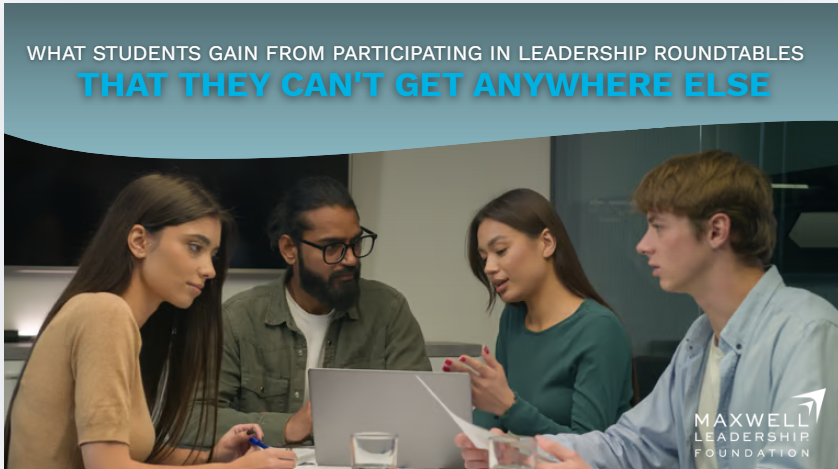

The culture that defines a school is rarely changed through edicts or directives. It is shifted through hundreds of small choices: to include rather than to exclude, to de-escalate rather than to engage, and to hold each other accountable even when there are no adults present. This is the contribution of the iLead curriculum, and the iLead student experience, that is changing student culture across the world today. And nowhere is that impact felt more keenly than in the lives and school culture of one small school in the capital city of Rwanda.
One Leader. One School. One Ripple
It began, as these things almost always do, with one leader. One principal in Rwanda decided to implement the iLead student curriculum throughout his school as not just a trial program, but as a committed effort to see it through to completion. And he did see it through. Over the course of five years, nearly 3,000 students in his school participated in the peer-facilitated roundtable discussions that are the mark of the iLead experience.
This one man’s school changed forever the cultural trajectory of an entire generation in Rwanda, and these changes were not limited to the classroom.
In Rwanda, where the pilot program began and continues to thrive today, the iLead student experience has grown into a national effort through continued work in Kigali.
This multi-faceted campaign was supported by both Rwanda’s Ministry of Education as well as local citizenry, and participants note the same cultural shift within their own students. Just as the principal’s school in Kigali underwent a cultural transformation, so too did the country’s youth, learning to be confident and aware individuals who lead with purpose and who, in turn, contribute meaningfully to their communities. These students who went through the process demonstrated increased self-awareness and self-confidence, with most reporting they served their communities, in part, as a result of their experiences with iLead.
This is the Maxwell Leadership Foundation effect, the “ripple,” in which one leader sparks a revolution. One leader trains another. One classroom changes another. One school’s impact is felt in another. And eventually, one small group of determined individuals can change the world. Rwanda never intended to begin a nationwide cultural shift through its one small pilot program. That is just the way that these things sometimes happen.
The Real Impact of Changing Student Culture In Schools
“Changing student culture” can be a nebulous concept, but it can also have very real implications for students and those who teach and lead them.
With iLead, those impacts can be measured in a variety of ways:
Fewer disciplinary issues: when students are asked to practice self-leadership, to name their values, to assess their individual behaviors in relation to those values, to commit to one action they will take differently in the next week, the result can be fewer disciplinary issues in schools or classrooms that adopt the program. Students who are reflecting individually, and then, most importantly, sharing that reflection aloud and in front of their peers, are likely to make better choices in general as they learn to understand themselves and the impact of those choices.
Stronger peer relationships: through the roundtable process of the iLead program, which takes place weekly in small groups of four to six students, students have opportunities to build relationships of true trust that might not exist in larger group settings in school. Those relationships, in turn, create stronger bonds and a stronger sense of accountability.
Shared classroom leadership: because the iLead facilitators rotate regularly, not staying in one place or one role, the responsibility for leading the class in this process is shared amongst many individual students, creating both an opportunity and expectation for shared leadership.
Service to self, others and community: many of the activities included in the iLead curriculum involve some type of service, whether to young students, to the classroom or to the wider community, and those relationships and service opportunities often extend beyond the school setting. The values practiced in the classroom are not left at the door, but rather continued and reinforced in the wider community.
A National Student Revolution, and Then Some
While Rwanda may be the most oft-cited example of a country undergoing a cultural shift because of the iLead curriculum, it is certainly not the only one. The same pattern, one school adopting the iLead student experience, in which students take ownership of their choices and their impact on themselves and others, and then seeing a measurable cultural shift in their classrooms and communities, follows a similar pattern in countries throughout Latin America and Africa. Students in Guatemala and Paraguay, some of the first adopters outside of Rwanda, went through similar processes of developing and practicing their values and leadership skills as part of the iChoose/iDo/iLead continuum. They, too, were inspired to make their own impact on their communities, and on the wider world.
Transform lives. Strengthen communities. Change nations. It is a powerful message, and one that is not just theoretical, it is an observable reality for students around the world, and one that is available for your students as well.
Why the iLead Student Curriculum Actually Works
It isn’t enough to have a single assembly or motivational speech, while such events can be powerful and inspiring, the effects they have are often short lived. When a school commits to an entire year of development and practice with their students through the iLead curriculum rather than just one assembly, the impact can be felt throughout the school year. By engaging in shared values and accountability with peers rather than with a single outside leader, students are more likely to adopt those values for themselves and carry them forward. When the person facilitating the iLead roundtable discussion with their peers is a student from the same school, rather than an outside expert, the values they are sharing become much more personal and relevant.
This is the multiplication mindset at the heart of the Maxwell Leadership Foundation ethos: leaders who train leaders, influencing and facilitating other leaders in turn, and it can have powerful effects in school communities, where those values are shared and practiced, again and again, among peers, with long-lasting impact.
Inspired to see a similar impact in your school or community? To learn more about the iLead curriculum and the impact it has made around the world, you can find more information at maxwellleadership.org.
“The most powerful ripple in any room belongs to the person who chooses to serve, not the person who is seen.”
What We Learned in Paraguay

The Stage Is a Microphone, Not a Generator
This is the core misunderstanding of how influence works. Most of us believe leadership influence flows like a broadcast signal: the more prominent the speaker, the more powerful the signal.
But influence doesn’t work like a broadcast. It works like a ripple. Ripples are generated by contact — by the specific, personal, relational moment in which one person’s character touches another’s.
🔗 Copy Link