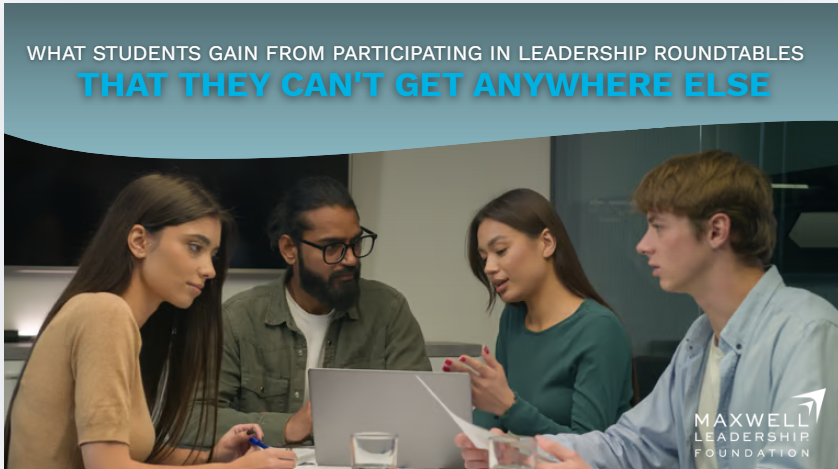

You can teach a student what a leader is. It is much more difficult to teach a student how to be one. Student Transformation Tables fill this leadership gap by providing real-life leadership opportunities for each student every week. Each week students engage in small group discussions doing exactly what leaders do: asking questions, leading meetings, disagreeing and drawing out the farthest voice at the table. These are all skills students will be able to take to college, at work and in life, long after they’ve forgotten a particular method of multiplication.
Leadership is influence, not position, but where it is most true is at a Transformation Table. The student assigned to lead has no authority but her own preparedness and presence.
Learning to Hold a Room
When students lead others, they learn to open with a question, read the room and figure out when the conversation has run out and they will know when the pause after asking a provocative question is the time when thinking starts. Such skills keep flowing into the boardroom, kitchen or anywhere conversation might take place as they learn to hold the interest of others.
While listening skills are often taught from one direction, at the Transformation Table listening skills are as likely to come from peers.
Learning to Listen
The students who lead their peers also learn to listen themselves, or the opposite, and get a sense of what works and doesn’t. Students practice rethinking and thinking through what they do when listening to a peer’s question or comment. They are required to ask a clarifying question to one colleague before they share their thoughts themselves. Students at a Transformation Table learn to read body language and recognize when a peer is distant, disengaged or just hasn’t had their voice heard yet. It’s simpler to fake listening to a friend than to a group of peers who know you well. Over a semester, this constant encouragement, though gentle and peer-based, makes you form new listening habits in real time at a Transformation Table.
The art of disagreeing is something that few people are prepared for in adult life. Fewer know the importance.
Learning to Disagree Without Division
Student Transformation Tables give students weekly opportunities to practice respectful disagreement in small group situations. Students learn to disagree with one’s ideas but not attack one’s person. Students are learning to take others’ positions, acknowledge dissent, and then work to return to the common purpose of the group. A good facilitator allows for disagreement to take place rather than shut it down. This one leadership skill students learn at a Transformation Table will serve them well in the future for they can remain at the table, physically and emotionally, when they face someone with another point of view.
In any group there is someone who speaks earlier and a later one. A good leader will notice this and open up for a dissenting voice.
Learning to Draw Out the Quiet Voice
An effective facilitator is able to recognize this and to hear the quieter students’ voices. To a student who hasn’t expressed their thoughts yet, asking a clarifying question is one way to begin to hear the quiet voice, which is a leadership skill that will eventually come in useful later in life. The habits at Transformation Table promote the students to pay attention to people, and even their peers, long before getting into a job. They learn character first before position and people first before process, and these are life lessons that will have staying power for students after going on to college.
What the students learn at Transformation Table isn’t just useful to them, it leaves a mark on those that students will lead one day. Student Transformation Tables help students learn how to be in charge of the room, listen to a room and have a voice, not to be afraid to disagree with and to be quiet about it. These skills last a lifetime, affecting how students navigate disagreements at work, lead projects and engage with the world.
Maxwell Leadership Foundation has seen this ripple effect on a huge scale, and a multi-year leadership initiative in Argentina that trained more than 200,000 leaders is inspiring leaders all across the region. The focus on leadership development has created its own ripple that others are now trying to figure out how Argentinean institutions have become so successful. So the influence of leaders who have learned to hold space for others begins at a Transformation Table.
Students who spend a year at a Transformation Table can graduate with many things, but most notably they leave with leadership skills that will last a lifetime. These are leaders who train and inspire the next generation of leaders long after they’ve left the halls of your school.
Get Started
The discussion skills learned in Transformation Tables for students don’t simply stay in the classroom. They follow your students for the rest of their lives. Visit maxwellleadership.org to get the iLead curriculum and the Transformation Table to your school.
“The most powerful ripple in any room belongs to the person who chooses to serve, not the person who is seen.”
What We Learned in Paraguay

The Stage Is a Microphone, Not a Generator
This is the core misunderstanding of how influence works. Most of us believe leadership influence flows like a broadcast signal: the more prominent the speaker, the more powerful the signal.
But influence doesn’t work like a broadcast. It works like a ripple. Ripples are generated by contact — by the specific, personal, relational moment in which one person’s character touches another’s.
🔗 Copy Link